Root Canal vs. Extraction: How to Make the Right Decision

Adult Dentistry
General Oral Care
Endodontics
Root Canal vs. Extraction: How to Make the Right Decision
When a tooth is severely decayed or infected, you may face one of the most common dilemmas in dentistry: should you save the tooth with root canal treatment, or have it extracted? This decision affects not just your immediate treatment experience, but your oral health and quality of life for decades to come.
Many people assume extraction is simpler and cheaper — but that's not always the case. This guide compares root canal treatment and extraction in detail so you and your dentist can make an informed decision together.
What Is a Root Canal?
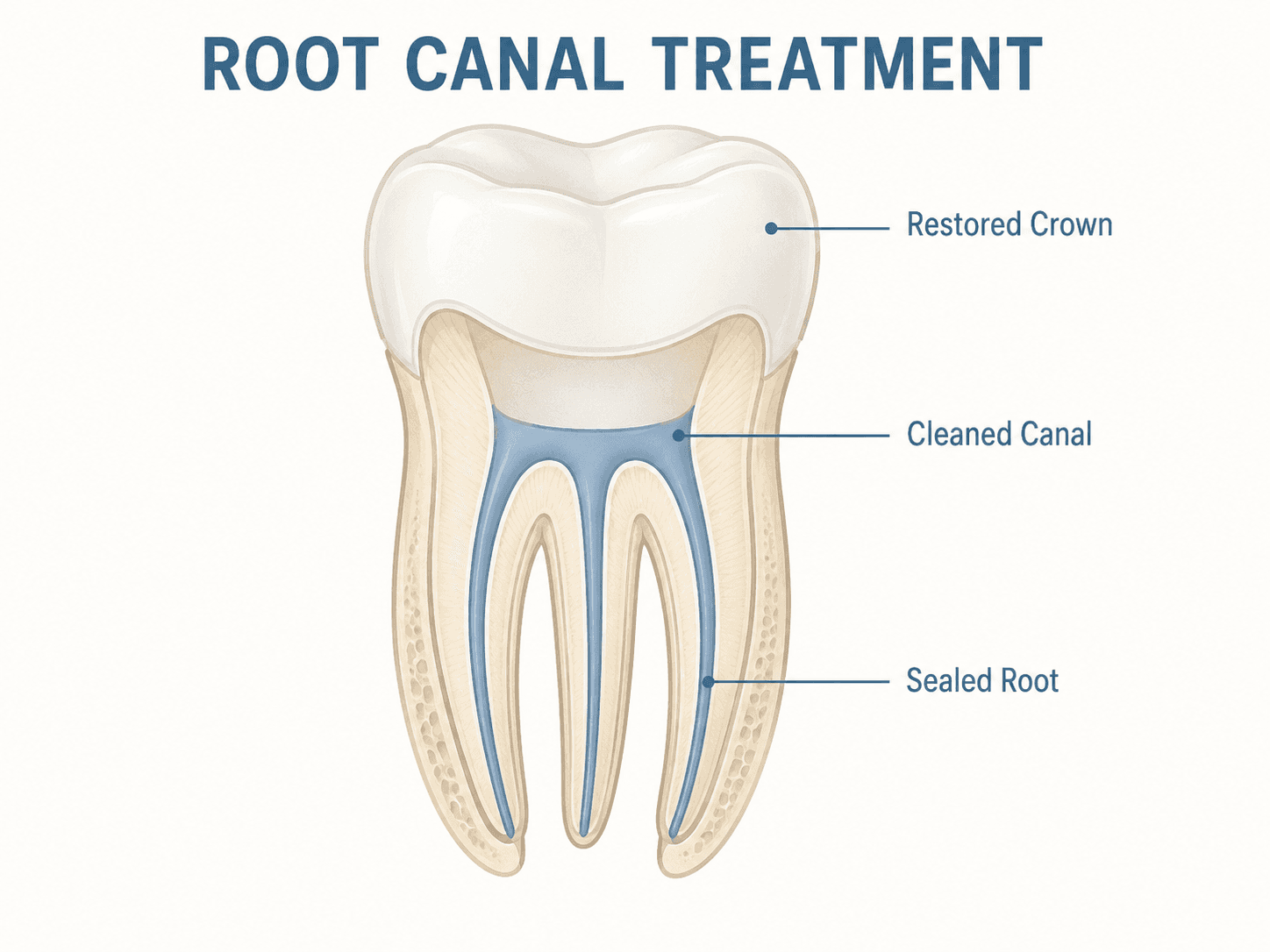
A root canal (known as 杜牙根 in Cantonese) is a treatment designed to save a tooth that is infected or severely damaged. When decay reaches the pulp — the soft tissue inside the tooth containing nerves and blood vessels — or when trauma causes the pulp to die, root canal treatment removes the infection while preserving the tooth structure.
The Root Canal Process
Diagnosis & X-ray — Assess the extent of infection and tooth structure
Local anaesthesia — Ensure a pain-free experience
Access opening — A small opening is made in the top of the tooth to reach the pulp chamber
Pulp removal — Infected or necrotic pulp tissue is removed
Canal cleaning & shaping — Specialised instruments clean and enlarge the canals
Disinfection — Antiseptic solutions thoroughly irrigate the canals
Filling & sealing — Canals are filled with biocompatible material (usually gutta-percha)
Restoration — A crown is typically placed to protect and strengthen the tooth
Good to know: Root canal treatment usually requires 1–3 appointments, depending on the tooth's location and severity of infection. Front teeth (incisors) typically have one canal and are simpler to treat; back teeth (molars) may have 3–4 canals and require more complex treatment.
When Is a Root Canal Needed?
Deep decay that has reached the pulp, causing severe toothache
Trauma that has caused the pulp to die
A dental abscess (periapical infection)
Preparatory treatment before extensive restoration
Secondary decay beneath an existing filling
When Is Extraction the Better Option?
While modern dentistry prioritises preserving natural teeth, there are situations where extraction may be more appropriate:
Severe fracture — A crack extends below the gum line, leaving insufficient structure for repair
Advanced periodontal disease — The tooth is loose due to severe bone and tissue loss
Failed root canal — A previously treated tooth becomes reinfected with a poor prognosis for retreatment
Root resorption — Significant resorption has weakened the root beyond repair
Positional issues — Such as impacted wisdom teeth causing recurrent infection
Financial considerations — In some cases, patients may opt for extraction due to budget constraints
Important: A gap left by an extracted tooth, if not addressed, allows neighbouring teeth to gradually shift. This can lead to bite problems, over-eruption of opposing teeth, and difficulty cleaning — creating a chain of further dental issues. Replacement treatment is usually necessary after extraction.
Root Canal vs. Extraction: A Detailed Comparison
Here is a comprehensive side-by-side comparison of both treatment options:
Factor | Root Canal Treatment | Tooth Extraction |
|---|---|---|
Goal | Preserve the natural tooth and eliminate infection | Remove the entire tooth |
Treatment time | 1–3 appointments, 60–90 minutes each | Usually one visit, 30–60 minutes |
Pain level | Similar to a filling; virtually painless under local anaesthesia | Surgical extractions can be more uncomfortable; more noticeable post-operative swelling |
Recovery | 1–3 days of mild discomfort | 1–2 weeks (longer for surgical extractions) |
Long-term outcome | With proper treatment and follow-up, the natural tooth can often be retained long term | Reliably removes the problem tooth, but the gap needs subsequent restoration |
Effect on adjacent teeth | None; original tooth alignment is preserved | Neighbouring teeth may shift; bite alignment can change |
Bone preservation | Root is retained, maintaining the jawbone | Jawbone gradually resorbs after extraction |
Long-Term Cost Considerations
Looking at the immediate cost alone, extraction is indeed less expensive than root canal treatment. However, extraction usually requires further restorative treatment (such as an implant, bridge, or denture), and the overall cost often exceeds that of a root canal. From a long-term perspective, preserving the natural tooth is often the more cost-effective choice. Exact costs vary by case — we recommend consulting your dentist for a detailed treatment plan.

Tooth Replacement Options After Extraction
If extraction is the final decision, understanding your replacement options is equally important. Common choices include dental implants, a bridge supported by dental crowns and bridges, and removable dentures:
Option | Description | Advantages | Disadvantages |
|---|---|---|---|
Dental implant | A titanium screw is placed in the jawbone, topped with an artificial crown | Closest to a natural tooth; no impact on adjacent teeth; prevents bone loss | Higher cost; requires surgery; longer treatment time (3–6 months) |
Dental bridge | An artificial tooth supported by crowns on the two adjacent teeth | No surgery required; faster treatment (2–3 weeks) | Requires shaving down two healthy adjacent teeth; does not prevent bone loss |
Removable denture | A removable artificial tooth | Lowest cost; no surgery | Less comfortable; weaker chewing force; requires daily cleaning |
💡Good to know: In some cases, an immediate implant can be placed at the same time as extraction, shortening the overall treatment timeline. However, this is not suitable for every situation — your dentist will assess bone quality and infection levels to determine eligibility.
How to Make the Right Decision
Choosing between root canal and extraction should be based on a careful evaluation, following a thorough dental examination, of several factors:
Favour root canal when:
The tooth structure is still largely intact and restorable
There are no significant root fractures
The surrounding periodontal tissues are healthy and the tooth is stable
The tooth is in an important functional position (e.g. a molar)
The patient has the budget to complete the full treatment
Consider extraction when:
The tooth is fractured severely below the gum line
There is a vertical root fracture
Advanced periodontal disease has made the tooth mobile
A previous root canal has failed and retreatment has a poor prognosis
There is insufficient tooth structure to support a crown
Key Questions to Ask Your Dentist
What is the prognosis for my tooth, and how likely is it to be saved?
What are the cost considerations for each option, including any subsequent treatment?
How many appointments will treatment require and how long will it take?
If I choose extraction, what is the best replacement option for me?
What are the consequences of not treating the tooth?

Frequently Asked Questions
Is root canal treatment painful?
Under local anaesthesia, root canal treatment is comparable in discomfort to having a filling. Modern dental techniques and anaesthetics have significantly reduced treatment discomfort. You may experience 1–3 days of mild soreness afterwards, which is usually manageable with over-the-counter painkillers. By comparison, surgical extractions typically involve more noticeable post-operative discomfort.
How long does a root canal treated tooth last?
Studies show that, with proper treatment followed by a crown, root canal treated teeth can generally remain functional over the long term. Many last 10–20 years or longer, provided good oral hygiene is maintained and regular check-ups are attended — though actual outcomes vary from tooth to tooth.
Do I always need a crown after a root canal?
A crown is strongly recommended after root canal treatment. Without its blood supply, the treated tooth becomes more brittle over time. A crown protects the tooth structure and significantly reduces the risk of fracture. Research shows that root canal treated teeth without crowns are up to 6 times more likely to fracture.
Can I leave the gap after an extraction?
This is not recommended. The space left by an extracted tooth allows neighbouring teeth to gradually drift, the opposing tooth to over-erupt, and the bite to change — potentially leading to jaw joint problems. Additionally, the jawbone at the extraction site will gradually resorb, and if you later decide on an implant, you may need additional bone grafting surgery. It is best to discuss replacement options with your dentist soon after extraction.
Do wisdom teeth always need to be extracted?
Not necessarily. If a wisdom tooth has fully erupted, is in the correct position, is easy to clean, and is not affecting adjacent teeth, it can be kept. However, if it is impacted (not fully emerged), repeatedly infected, crowding neighbouring teeth, or causing decay, extraction is usually recommended. Your dentist will provide personalised advice based on X-ray findings.
Which is better — root canal or extraction followed by an implant?
In most cases, if a tooth can be saved with root canal treatment, this is the preferred option. Natural teeth have a periodontal ligament that provides natural bite sensation and cushioning — something implants cannot fully replicate. Research also shows that, with proper treatment and follow-up, the long-term outcomes of root canal treated teeth and implants are comparable, and both can be reliable long-term options. However, if the tooth has a poor prognosis, timely extraction followed by an implant is also an excellent solution. To understand implants in more detail, you may read this complete guide to dental implants.
Final Thoughts
When choosing between root canal treatment and extraction, the most important thing is to make an informed decision based on your specific situation, in close consultation with your dentist. Every tooth is different, and there is no one-size-fits-all answer.
If you are facing this decision or have any questions about root canal treatment and extraction, you are welcome to contact our clinic for a consultation to determine whether further assessment or treatment is needed.

Book an Appointment
Schedule your visit now for personalized care in a comfortable environment. Your journey to a brighter, healthier smile begins here.