
Thumb Sucking & Oral Habits: How They Affect Your Child's Teeth

Children's Dentistry
Family Dentistry
General Oral Care
Thumb Sucking & Oral Habits: How They Affect Your Child's Teeth
Many young children develop oral habits such as thumb sucking, lip biting, or mouth breathing. Parents often assume these will stop on their own. While that is sometimes true, if these habits persist into the mixed dentition stage (when permanent teeth begin to emerge), they can have lasting effects on tooth alignment and jaw development. Identifying and addressing these habits early — often through routine children's dentistry assessments — is one of the most effective ways to prevent the need for orthodontic treatment later.
This guide covers the most common childhood oral habits, how they affect dental development, recommended ages to stop, and practical strategies to help your child quit.
Common Childhood Oral Habits
The following are the oral habits paediatric dentists most frequently encounter that can significantly impact dental development:
Thumb sucking / finger sucking: A natural self-soothing behaviour in infants, but prolonged sucking applies pressure to the upper jaw and front teeth
Lip biting / nail biting: Repeatedly biting the lower lip pushes the lower front teeth inward and the upper front teeth outward; nail biting can wear down tooth edges
Tongue thrusting: A swallowing pattern where the tongue habitually pushes forward against the front teeth, which over time can cause an anterior open bite
Mouth breathing: Whether caused by nasal congestion or habit, breathing through the mouth affects jaw growth, leading to a narrow dental arch and changes in facial shape
Prolonged pacifier use: Similar to thumb sucking, extended pacifier use places pressure on the upper jaw and front tooth alignment
If you notice any of these habits in your child, we recommend scheduling a dental assessment sooner rather than later — see our guide on when your child should first visit the dentist for age-by-age recommendations.
How Do These Habits Affect Dental Development?
The impact of oral habits on teeth depends on frequency, intensity, and duration. When habits persist long-term, they may lead to the following issues:
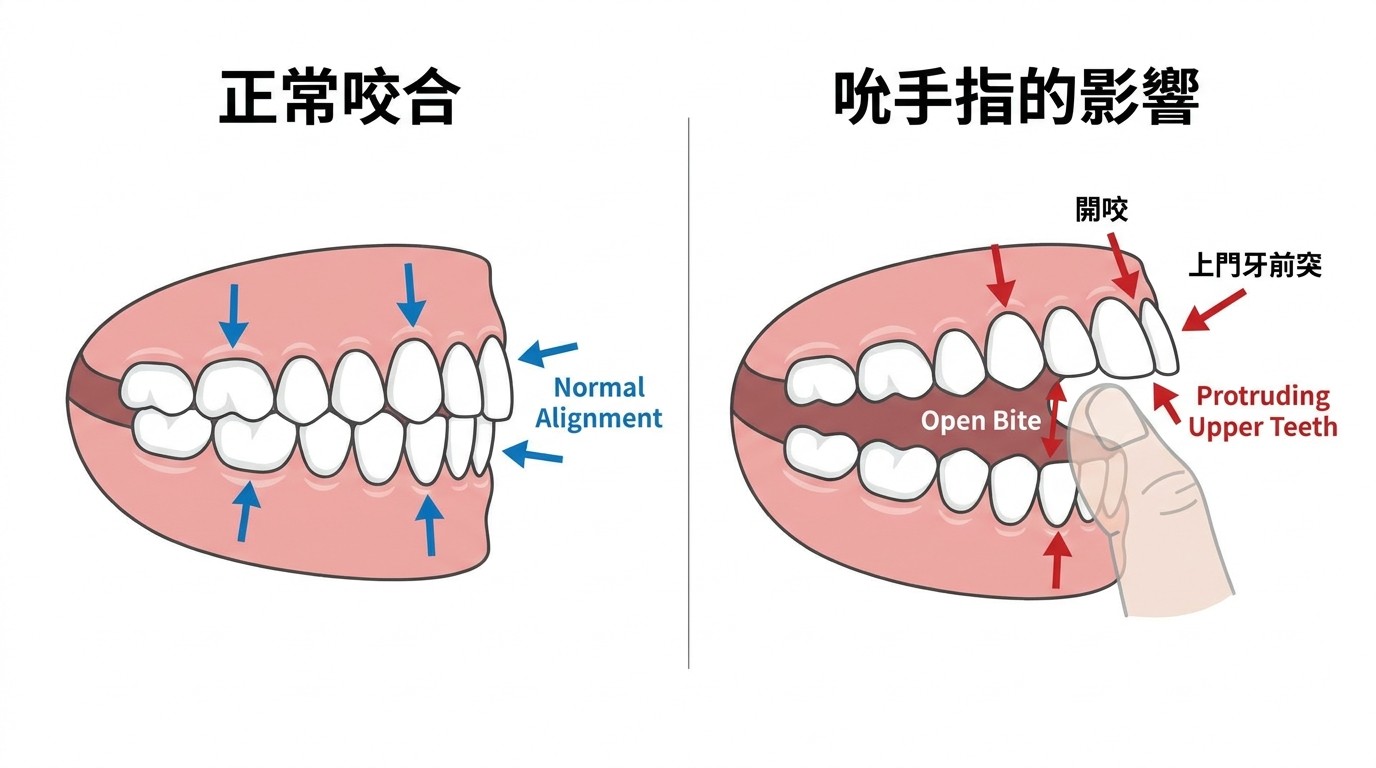
Open Bite
The upper and lower front teeth cannot meet when the mouth is closed, leaving a visible gap. This is most commonly seen in children who thumb suck or tongue thrust for extended periods. An open bite affects the ability to bite into food and may also impact speech.
Increased Overjet (Protruding Front Teeth)
The upper front teeth flare noticeably forward. This is common in children who suck their thumb or habitually bite their lower lip, as the sustained pressure pushes the upper incisors outward.
Narrow Dental Arch
Chronic mouth breathing changes the resting position of the tongue (which should normally rest against the roof of the mouth). Without this natural expansion force, the upper jaw becomes narrow, leading to crowded and misaligned teeth.
Posterior Crossbite
When the upper jaw is too narrow, the upper back teeth may bite inside the lower back teeth instead of outside them. This affects chewing efficiency and can even lead to asymmetric jaw growth.
When Should These Habits Stop?
Different habits have different recommended timelines:
Habit | Recommended Age to Stop | Notes |
|---|---|---|
Thumb / finger sucking | Before age 3–4 | Stopping before permanent incisors erupt usually prevents lasting damage |
Pacifier use | Before age 2–3 | The earlier the better to avoid affecting the shape of the upper jaw |
Lip biting / nail biting | As soon as possible | Often linked to anxiety or boredom — address the root cause |
Tongue thrusting | Before age 6–8 | Best corrected before the mixed dentition stage; may require professional therapy |
Mouth breathing | As soon as possible | Rule out medical causes (e.g. enlarged adenoids, allergies) first, then combine with oral exercises |
Key principle: Most oral habits, if stopped before the permanent teeth erupt (around age 6), cause changes that are typically reversible. If habits continue beyond this point, orthodontic treatment may be needed to correct the resulting issues.
How to Help Your Child Break the Habit
Breaking an oral habit requires patience and positive reinforcement. Avoid scolding or punishment, as this can increase anxiety and actually reinforce the habit. If your child is also nervous about dental visits, see our guide on helping children overcome dental anxiety.
Positive Encouragement
Set small, achievable goals (e.g. "no thumb sucking during the day today") and praise success
Use a reward chart so your child can visualise their progress
When you notice the habit, gently remind rather than criticise
Substitute Strategies
Offer alternative comfort items (e.g. a soft toy, stress ball)
Keep hands busy with activities (drawing, puzzles, building blocks)
Try gloves or finger guards at bedtime
Professional Intervention
Orofacial myofunctional therapy: For tongue thrusting and mouth breathing, a speech therapist or dentist can design exercises to retrain the tongue and lip muscles
Habit breaker appliance: A fixed device on the upper jaw that reminds the child not to place their finger or tongue into the mouth
ENT assessment: If your child is a chronic mouth breather, an ear, nose and throat specialist should first rule out enlarged adenoids or nasal allergies

Does My Child Need Orthodontic Treatment?
Not every child with an oral habit will need braces or clear aligners. Whether intervention is necessary depends on:
Whether the habit has stopped: If the habit has been broken and the child is still growing, some bite issues may self-correct
Severity of the effect: Mild open bites or overjet may resolve with growth; more significant bite problems will likely need orthodontic correction
The child's age: Ages 6–8 are the ideal window for an early orthodontic assessment, as growth potential can be harnessed to guide jaw development
If you notice that your child has a persistent oral habit and their teeth are already showing signs of misalignment, we recommend seeking a dental assessment sooner rather than later. Early intervention is often simpler and more effective than waiting until all permanent teeth have erupted. Regular check-ups also help catch other common concerns early, such as childhood cavities.
📖 Further reading: Children's Orthodontics: A Complete Guide to Early Treatment
Frequently Asked Questions
Until what age is thumb sucking considered normal?
Thumb sucking is a natural self-soothing behaviour in infants. Most children stop on their own between ages 2 and 4. If the habit persists beyond age 4, it is advisable to actively encourage stopping before it affects the incoming permanent teeth.
Can mouth breathing really change my child's face shape?
Yes. Long-term mouth breathing alters the growth pattern of the facial muscles and jaw, potentially resulting in "long face syndrome" — an elongated face, receding chin, and narrow dental arch. Addressing nasal obstruction early and incorporating orofacial exercises can help restore normal facial development.
Which is worse for teeth — a pacifier or thumb sucking?
Both have a similar effect on teeth. However, pacifiers are generally easier to wean (you can gradually reduce use or "lose" it), while thumb sucking is harder to stop because the thumb is always available. Regardless of the habit, stopping before age 3–4 usually prevents any permanent impact.
Does my child need to see a dentist about nail biting?
Occasional nail biting typically does not cause serious dental problems. However, if the habit is frequent and persistent, it may lead to worn tooth edges or slight shifting of the front teeth. We recommend identifying the underlying trigger (often anxiety or boredom) and using positive reinforcement to help your child break the habit.
How can I tell if my child is a mouth breather?
Common signs include: sleeping with the mouth open, snoring, waking up with a dry mouth, frequently chapped lips, and habitually keeping the mouth open during the day. If you notice these signs, we recommend consulting both an ENT specialist and a dentist to identify the cause and develop a treatment plan. A routine dental check-up is a good starting point for a full assessment.
Childhood oral habits may seem harmless, but if they persist beyond the age when permanent teeth begin to emerge, they can affect tooth alignment and facial development. The good news is that most habits, when addressed at the right age, cause changes that are fully reversible. If you have any concerns about your child's oral habits, you are welcome to contact our clinic for a consultation.
Have a question? Get in touch via WhatsApp:


Book an Appointment
Schedule your visit now for personalized care in a comfortable environment. Your journey to a brighter, healthier smile begins here.